Blog November 19, 2026
How Much Does It Cost to Build a White-Label EV Charging Software Platform in 2026?
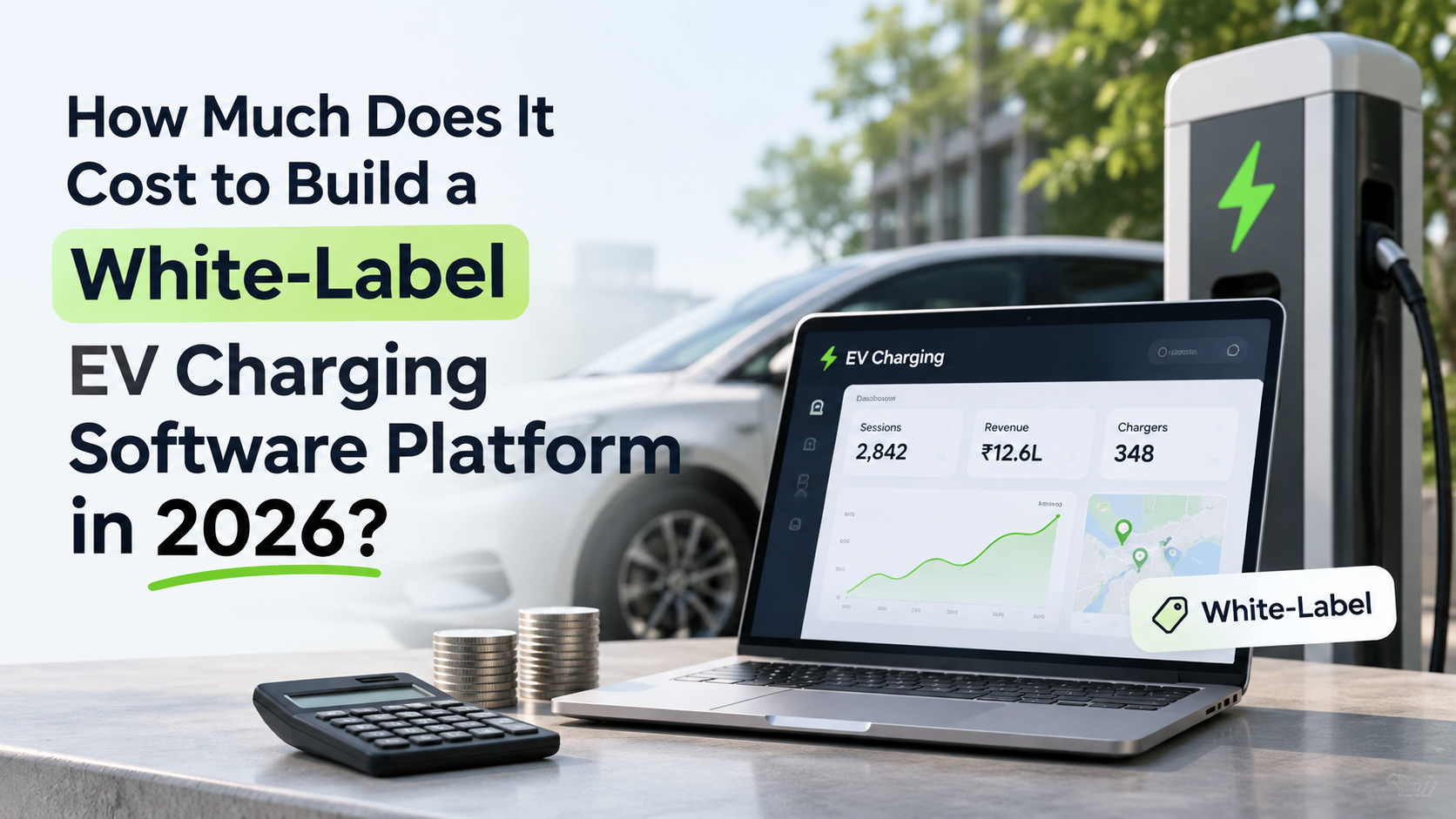
If you sell EV chargers, the hardware was never really the hard part. A charging station that can’t talk to an app, can’t take a payment, and can’t tell a driver whether it’s actually free right now is just an expensive parking bollard.
That’s the real reason so many charger manufacturers and charge point operators end up asking the same question: do we build our own software from scratch, or do we put our brand on a platform that already exists? Before that decision makes sense, it helps to know what you’re actually pricing out — and what it really costs in 2026.
What’s Actually Inside an EV Charging Platform
“EV charging software” is really five or six separate pieces of software wearing one trench coat:
- Driver app – find a nearby charger, check if it’s actually free, start/stop a session, pay, see your charging history.
- CPO (charge point operator) dashboard – the back-office view for monitoring every station, pricing by location, and spotting a charger that’s gone offline before an angry driver does.
- OCPP integration – the open protocol that lets software actually talk to charging hardware, regardless of who manufactured it. Get this wrong and nothing else works.
- Payments and billing – card payments, wallets, RFID cards, subscription plans, invoicing for fleet or B2B customers.
- Admin and reporting – usage analytics, revenue reports, uptime tracking, the stuff a business actually runs on.
Miss one of these and you don’t have a smaller product — you have a support ticket queue.
The Real Cost Breakdown
Building this from scratch is a real software project, not a weekend sprint — and the price tag moves a lot depending on how complete you need day one to be.
| Tier | What you get | Typical cost | Typical timeline |
|---|---|---|---|
| Basic MVP | Driver app + simple CPO dashboard, one OCPP version, one payment method | Lower end of a custom build | 3–4 months |
| Mid-tier | Full driver + CPO apps, multi-protocol OCPP, multiple payment/RFID options, basic analytics | Mid-range | 5–7 months |
| Full-featured | Everything above + fleet/B2B billing, advanced reporting, multi-tenant white-labeling, roaming network support | High end | 8–12+ months |
Those numbers assume a from-scratch custom build with a dedicated dev team. A white-label platform — one already built, tested, and running for other operators, that simply gets re-skinned with your brand — collapses both the cost and the timeline dramatically, because the hard, unglamorous parts (OCPP compliance, payment gateway integration, uptime monitoring) are already solved.
What Pushes the Price Up (or Down)
A few things move the number more than anything else:
- How many hardware brands you need to support. Supporting only your own chargers is simple. Supporting every charger your network partners bring is a much bigger integration job.
- Payment complexity. A single card gateway is easy. RFID cards, fleet invoicing, subscription plans, and multi-currency support each add real engineering time.
- Network size and roaming. A handful of stations is one thing. Thousands of stations across multiple cities — with load monitoring and failover — is a different scale of engineering.
- White-labeling for resale. If you want to resell the platform under other brands (multi-tenant), that’s an architecture decision, not a feature you bolt on later.
- Compliance and localization. Region-specific payment rules, data residency, and language support all add scope depending on where you operate.
The pattern across all of these: the things that actually swing cost are the back-end plumbing most buyers never think to ask about — not the parts of the app that look nice in a demo.
Build From Scratch, or Go White-Label?
Building from scratch makes sense when your charging software genuinely needs to be unlike anything else on the market, and you have the budget and the runway to spend close to a year getting it right.
For most charger manufacturers and charge point operators, though, the smarter move is going white-label: taking a platform that already handles OCPP, payments, and uptime correctly, and launching under your own brand in weeks instead of months — at a fraction of the cost of building it yourself.
That’s exactly what EV TechStack, our white-label EV charging platform, is built for – your brand on top, the hard engineering already done underneath. If you’re an EV hardware brand or a charge point operator weighing build vs. buy, talk to Synapse Tech Solutions and we’ll walk you through what a white-label launch would actually look like for your network.

Next.js vs WordPress vs Webflow: Which Should You Pick for Your Business Website in 2026?
Every business owner picking a website platform in 2026 runs into the same wall: there are too many good options and not enough time…
Read article
How Much Does It Cost to Build a Mobile App in 2026?
The “app gold rush” has matured into an era of high-stakes engineering. In 2026, building a mobile app is no longer just about writing…
Read article
From Blind Spots to Blueprints: Mastering Real-Time Server Observability with Prometheus & Grafana
In the world of DevOps, flying blind is a recipe for a 3:00 AM disaster. If you aren’t monitoring your infrastructure, you aren’t managing…
Read article